9th Apr, 2026 10:00
East Anglian, Antiques & Fine Art


1090
Harry Becker (1865-1928) oil on canvas - Blythe Valley Landscape with Farm Buildings
Harry Becker (1865-1928) oil on canvas - Blythe Valley Landscape with Farm Buildings, 46 x 59cm, framed. Probably painted in late autumn, on a day that threatened rain, and unusually for a canvas of this size, on the spot. Wonderfully atmospheric
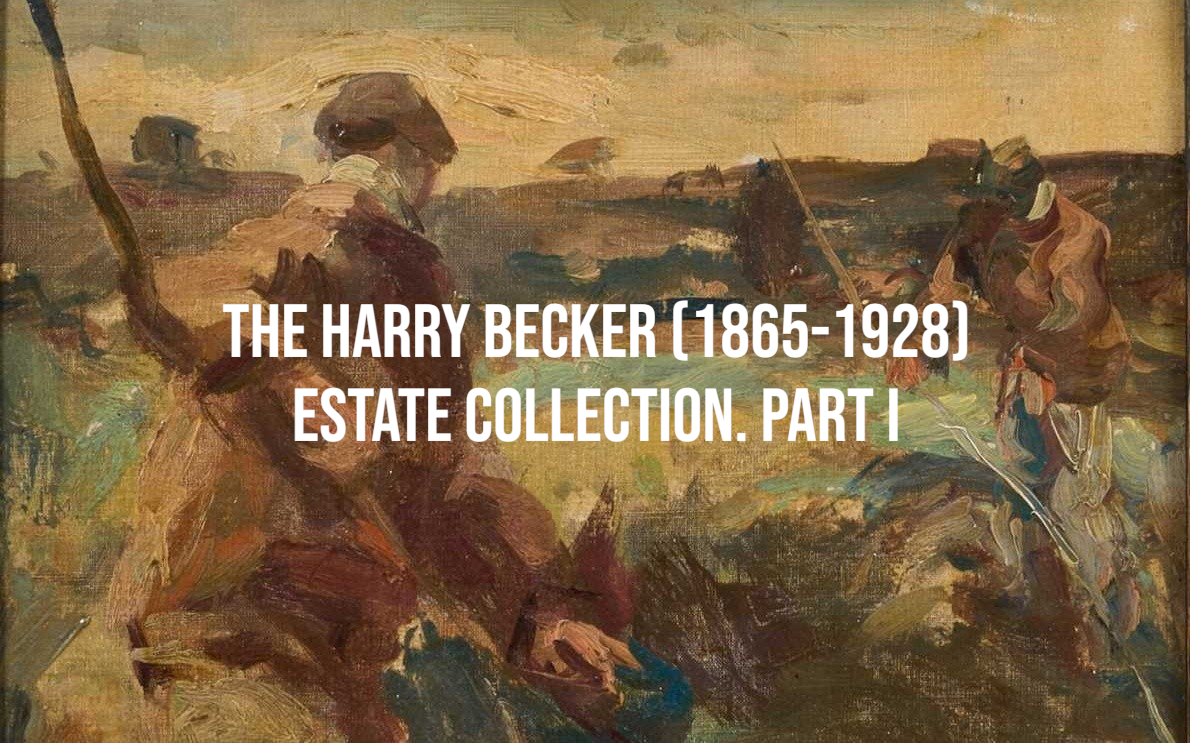
The Harry Becker (1865-1928) Estate Collection. Part I
Harry Becker was born in Colchester in 1865 to German parents Henrietta and Charles. His father Charles, who served as a field surgeon in various campaigns including Crimea, was drafted to Colchester in 1856 and there they settled. Charles became a well‑respected GP, and Harry, along with his six siblings, grew up in the town. From 1884 to 1902 the family lived at The Minories—now an exhibition space that has operated as a gallery since the 1950s.
Becker began his formal artistic training at the age of fourteen when he enrolled at the Royal Academy of Fine Arts in Antwerp. He narrowly missed working with Vincent Van Gogh, who enrolled the year after Becker left. He completed his studies with a scholarship to the fashionable Bushey School of Art under Hubert von Herkomer, before joining the Paris studio of Carolus‑Duran. This atelier encouraged rapid, direct work from life, avoiding over‑working a piece in order to retain the freshness of the initial sketch. It was a method embraced by the studio’s most celebrated student, John Singer Sargent, and by Becker himself, who learned to capture the essence of his subject with remarkable brevity. Adrian Bell later recalled visiting Becker’s widow Georgina in the 1940s and admiring a small oil painting, only to be told he had spent longer looking at the work than it had taken Becker to paint it!
After his studies, Becker returned to Colchester and from 1888 kept a studio at Valley Farm, Flatford, in the heart of Constable Country. In 1894 he made the necessary move to London to be closer to galleries and exhibitions, though he continued to make frequent forays back to East Anglia as well as Kent, and made annual trips to Holland in search of agricultural subjects for his work. In 1902 he married fellow artist Georgina Waddington, whom he had met at the Bushey School of Art, and they settled into a studio home in West Kensington. Their daughter Janet was born the following year.
During the next decade Becker’s reputation rose steadily. His first solo exhibition, held in 1905 at the Baillie Gallery, consisted entirely of lithographs on an agricultural theme. Print runs were strictly limited to thirty‑five impressions, and several editions sold out completely. He was soon widely acknowledged as a master printmaker and, alongside Brangwyn, Nevinson and Augustus John, became a founder member of the Senefelder Club, established to promote lithography. Becker was also at the forefront of contemporary painting, exhibiting with the New English Art Club alongside Sickert, Orpen, Steer and other leading lights, at the Salon des Indépendants in Paris, and at the New Association of Artists. In 1911 his painting Dutch Peasant Women Gathering Potatoes was named one of the Royal Academy’s pictures of the year.
A year later he achieved a career‑defining moment with an exhibition at the Meryon Gallery in London’s Mayfair. Its success led to a fortnight long extension, and thirteen works from the show were selected for inclusion in William Beach Thomas’s ‘The English Year’, which also featured contributions from Alfred East and George Clausen.
Yet in the midst of his artistic fruition, Becker suffered a series of personal and professional events which would unbalance him. The death of his young son in 1909 and of his father in 1910 were followed by the haunting collapse of a major commission for mural designs for Selfridges’ central hall. Gordon Selfridge questioned the accuracy of Becker’s depictions of scythers—an affront to an artist committed to absolute truth in representation. Becker refused to alter his designs and the commission was lost. Then, in 1911, intense media coverage of a court case concerning the annual Earls Court Fun Fair—whose noise had for years jangled his nerves and made work difficult—cast him in the newspapers as a killjoy. These painful events, coupled with rising anti‑German sentiment in pre‑war Britain, to which Becker was always particularly sensitive, weighed heavily on him. Ultimately, it was Becker’s own discomfort with the commercialism and self‑promotion required by the London art world that led him, in 1912, to relocate permanently to the countryside.
At the age of forty‑eight, Becker, Georgina and Janet moved to Wenhaston in Suffolk’s Blyth Valley. Here he embraced a more reclusive life, dedicating himself wholly to his work and developing a style shaped by isolation from outside influence. He immersed himself in the cycle of the agricultural season, rising early, often at 5am to accompany plough teams into the fields, synchronising his swift, focussed mark‑making with the rhythmic actions of the farm workers. Although his productivity remained remarkable, exhibitions and sales slowed markedly. He showed several pieces at the Venice International Exhibition in 1913 and intermittently with the Royal Society of British Artists and the Royal Scottish Academy. With the exception of a couple of London Underground commissions for lithographic posters, sales almost entirely dried up. The cost of sending work to London became prohibitive,and the risk was demonstrated in 1914 when fifteen lithographs bound for the Leicester Galleries were destroyed when a railway truck rode over the parcel.
Becker became almost wholly reliant upon wages which Georgina brought in from an Art teaching job she secured at St Felix School, Southwold, and from the support of a few local patrons, most notably the Loftus family of Southwold. Harry also grew increasingly disinclined to part with his work, he wrote “I think it’s so disheartening to give away your pictures, because then they’re hung on the walls and nobody ever looks at them again”. Materials were scarce and Becker used whatever he could scratch together, working on scraps of card, the backs his wife’s students’ work, on greaseproof paper, even on old sacking.
His best works were produced during these richly creative Suffolk years, which continued until his death from pneumonia in 1928. He was almost forgotten until Adrian Bell selected Becker’s drawings to illustrate the 1948 edition of his best‑selling farming trilogy. When Georgina died in 1958, the majority of Becker’s works passed to the Loftus family, who continued to champion his legacy through numerous exhibitions.
Becker’s career narrowly preceded a revolution in traditional agricultural methods, he chronicled the daily grind of man and horse unchanged for centuries with brilliant immediacy and free from the sentimentality which traditionally accompanied rural subjects. His work has since become synonymous with the literature, music and social anthropology of East Anglian rural life. Becker’s ability to capture the essence of the Suffolk countryside—with consummate command across a range of media, refined during his years of self‑imposed exile, firmly establishes him within the East Anglian artistic tradition, an artist of substance from the same soil as Constable and Crome.
Sold for £2,000
In Person
To bid in person at auction for the first time please register for a bidding number in advance by filling out and submitting a registration form at reception. When registering in person we require photo ID, such as a passport or driving licence.
Live Internet Bidding
We are pleased to offer a live online bidding service through our website platform ReemansLive.*
ReemansLive offers an excellent auction experience on your desktop, phone or tablet without being in the room. The platform is complete with live audio and video feeds to enable you to watch and hear the auction as it happens wherever you are in the world. Additionally you are able to see opposing bids in real time and view the upcoming lots.
A Bid Live button will appear on our home page when the sale is live. Simply click this to sign in & begin.
New users will need an online account with us to participate in live auctions via ReemansLive. Once you have created your account and registered card details, you will be approved to bid for the auction.
*Please note that if you bid through our website you will be charged an additional 3% (plus VAT) commission on the hammer price.
Alternatively you can bid via www.the-saleroom.com To bid online, simply register with the-saleroom.com and visit the site on the day of the sale. Please note that if you bid through the-saleroom.com, you will be charged an additional 4.95% (plus VAT) commission on the hammer price.
Create an account
Absentee Bidding
For clients unable or not wishing to attend our sale we are happy to accept absentee bids. Absentee bids can either be left in person with our office team, phoned or emailed to us. We simply require lot numbers and descriptions and the maximum bid which you wish to leave. Absentee bids are then transferred to our auction pages and the auctioneer will bid on your behalf. If the lot can be purchased at a lower price than your maximum bid our auctioneers will always endeavour to work in your interest to purchase the lot for you as cheaply as other bids will allow. If the same bid is left by two people on a lot we will precedence to the bidder who leaves the bid first.
We are happy to provide condition reports for online and absentee bidders and to supply additional photographs on any lot. We ask that condition report requests are submitted at least 24 hours prior to the sale. (Whilst every care is taken to give an accurate condition report, we accept no responsibility for any omissions or errors in our reports. It is the buyer’s responsibility to view the lots and satisfy themselves as to their condition.)
Telephone Bidding
We are happy to accept phone bids for our Fine Art and Collectors’ sales. Phone bids may be arranged in person with our office team, by phone or by email. We simply require the lot number and details of the lots which you wish to bid on and contact phone number / numbers. Our phone bidders will call in advance of your chosen lot / lots and bid on your behalf during the sale.
Telephone bids must be booked by 4pm the day before the sale but can be arranged earlier, we have limited lines and certain lots can be over-subscribed for phone bidding, in such instances we conduct a first come, first served basis and we encourage clients to book well in advance or risk being disappointed.
Auction: East Anglian, Antiques & Fine Art, 9th Apr, 2026
.png)
.png)
Viewing
Thursday 2nd April 1pm - 5pm
Saturday 4th April 9am - 1pm
Tuesday 7th April 9am - 6pm
Mornings of sale from 9am
Full Terms & Conditions relating to our auctions can be found here
Here at Reeman Dansie, we are happy to offer a complimentary online valuation service. Please fill out the form and press the 'Submit' button below.
To help us with your valuation please attach clear photographs of the item where possible. You can submit up to 5.
Approximate dimensions are also useful. Expect to hear from the appropriate valuer as soon as possible.